

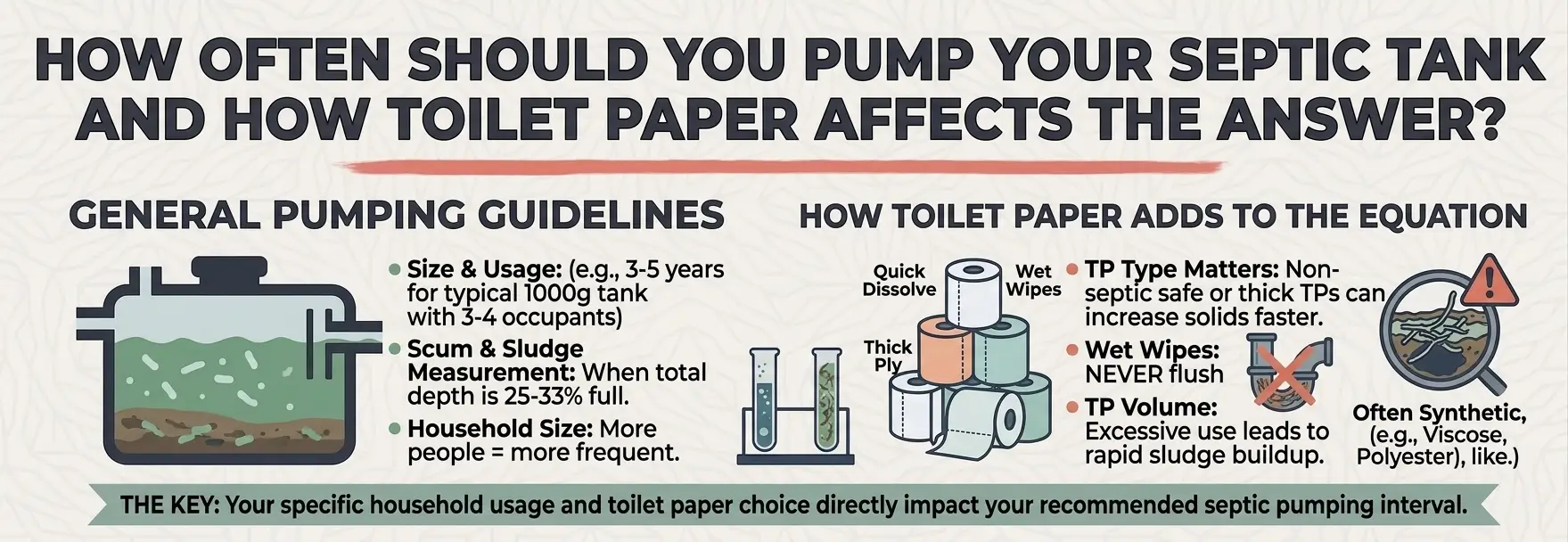
How Often Should You Pump Your Septic Tank and How Toilet Paper Affects the Answer
If you own a home with a septic system, at some point someone has told you to pump every three to five years. That advice comes from the EPA and most state septic management guidelines. It is reasonable general guidance, but it is based on assumptions that may or may not match your actual situation.
The real answer to how often you should pump your tank depends on three variables: the size of your tank, the number of people using the system, and the rate at which your tank accumulates sludge. That third variable, sludge accumulation rate, is the one most people do not think about. And it is the one most directly affected by the toilet paper you use.
How Pump-Out Frequency Is Calculated
The basics: tank size and household size
Septic tanks come in different sizes, most commonly 750, 1,000, or 1,500 gallons for residential systems. Larger households or homes with higher water use typically have larger tanks. The calculation for pump-out frequency starts with how much sludge and scum your household generates relative to the tank’s total capacity.
As a general benchmark: a household of two people with a 1,000-gallon tank needs pumping approximately every five to six years. A household of four with the same tank needs it every three to four years. A household of six with a 1,000-gallon tank might need pumping every two years. These are averages based on normal waste generation and normal toilet paper use.
The third variable: sludge accumulation rate
Sludge accumulates faster when your tank receives material that is slow to biodegrade. Toilet paper is one of the main contributors. A household using thick, slowly-biodegrading conventional toilet paper will accumulate sludge faster than a household using fast-dissolving, fully biodegradable paper, even if everything else is the same.
The difference in accumulation rate is not dramatic in a single flush. It is cumulative. Over three years of daily household use, the difference between a toilet paper that biodegrades 95 percent in 28 days and one that biodegrades 100 percent in 28 days is real, even if the per-flush contribution is small.
What a Septic Inspection Actually Checks
Measuring sludge and scum depth
When a septic service provider visits your property, one of the first things they do is measure the depth of the sludge layer at the bottom of the tank and the scum layer at the top. These measurements tell them how full the tank actually is and whether it is approaching the point where solids might pass into the drain field outlet.
A well-maintained tank with three-year-old contents from a household of four might show a sludge depth of eight to twelve inches. The same tank maintained on the same schedule but with a higher sludge accumulation rate might show fourteen to eighteen inches. The difference is where pump-out frequency becomes a practical management decision rather than a textbook guideline.
What inspectors look for beyond the numbers
A good inspector also checks the baffles at the tank inlet and outlet, which direct the flow of wastewater and prevent solids from passing too early into the drain field. They look for signs of solids carryover into the outlet pipe, which would indicate the tank is operating under stress. And they check the drain field for signs of saturation.
In a household where toilet paper is dissolving and biodegrading quickly, baffles tend to stay cleaner. The inlet baffle in particular sees less accumulation of undissolved paper. The outlet baffle faces less pressure from a sludge layer that is climbing toward it.
Signs Your Pump Schedule Needs Adjusting
When the benchmark is not matching reality
If your septic service provider is recommending pump-outs more frequently than the general guidelines suggest you should need them, that is worth investigating. The possible reasons include a tank that was undersized for the household when installed, a garbage disposal that adds significantly to sludge generation, or paper products that are not biodegrading at the rate they should.
Many homeowners discover their tank fills faster than expected without ever connecting it to their toilet paper choice. The paper is an easy variable to adjust, and it is worth ruling out before spending money on other interventions.
Slow drains across multiple fixtures
When drains slow down across the house at the same time, not in a single fixture, that is typically a sign of a problem between the house and the tank or inside the tank itself rather than a localized plumbing issue. Undissolved paper accumulating at the inlet, in the pipe between the house and the tank, or creating unusual pressure dynamics inside the tank can contribute to this.
The lawn is telling you something
Unusually green, unusually lush grass in a specific area above your drain field can indicate effluent reaching the surface of the soil. In very early stages, this looks like fertilization. As it progresses, the area gets wet, the ground gets soft underfoot in dry weather, and eventually the odor arrives.
Any of these signs mean your system needs professional inspection immediately. But the contributing factors upstream, including what has been entering the tank for the past several years, are worth understanding even once the immediate problem is addressed.
How Toilet Paper Choice Affects Your Real Pump Schedule
The math on biodegradation and sludge rate
Here is a simplified way to think about the connection. If your household uses 400 rolls of toilet paper per year and each roll leaves five percent of its mass as residual material in your tank, that is 20 rolls worth of undegraded paper fiber building up annually. Over three years, that is 60 rolls of residual accumulation sitting in your sludge layer.
If that same household switches to toilet paper that biodegrades 100 percent within 28 days, the residual is significantly less. The sludge layer grows more slowly. The time between pump-outs can extend. The math is approximate because real tank conditions are more complex, but the direction is reliable: fully biodegrading paper means slower sludge accumulation.
Additives affect biological breakdown too
Toilet paper containing synthetic fragrances can suppress the anaerobic bacteria responsible for sludge breakdown in your tank. When bacterial activity slows, sludge accumulates faster even at the same input rate. Throne Bamboo contains no fragrances, no dyes, and no PFAS. It does not introduce anything into your tank that works against the biological processes responsible for keeping your sludge level manageable.
A Practical Schedule Based on Your Situation
The general guidelines
If you are using a properly sized tank and fast-dissolving, fully biodegradable toilet paper, the general guidelines are reasonable starting points. One to two people in a 1,000-gallon tank: pump every five to six years. Three to four people: every three to four years. Five or more: every two to three years.
These assume no garbage disposal, moderate water use, and no unusual inputs. Add a garbage disposal and move each estimate a year or two shorter. Add heavily processed, slow-biodegrading toilet paper and do the same.
Getting your system professionally evaluated
The most reliable way to know your specific pump schedule is to have your tank inspected by a licensed professional and have them measure your sludge and scum depths during or after pumping. Ask them to note the depths before pumping so you have a baseline. Then have them check again in 12 to 18 months to measure the accumulation rate. From there, you can calculate your actual, household-specific interval rather than relying on the general guidelines.
What Switching to Bamboo Toilet Paper Actually Changes
Switching to a fast-dissolving, fully biodegradable toilet paper like Throne Bamboo does not repair damage that has already accumulated in your tank. What it does is reduce the amount of slowly degrading paper entering the system going forward.
Your tank processes incoming paper more efficiently when the paper is breaking down quickly and biodegrading completely. Your sludge accumulation rate slows. Your pump schedule can extend toward the longer end of the guidelines for your tank size and household size. And the biological environment in your tank is not being disrupted by fragrance compounds or other additives from the paper itself.
Over five years, the combination of a longer pump interval and a healthier tank environment is a real cost difference. Throne Bamboo’s SGS testing confirms 100 percent biodegradation within 28 days and dissolution beginning in 10 minutes. Those numbers translate directly into a tank that can operate closer to its design specification and a drain field that handles effluent the way it was built to handle it.
More blog posts
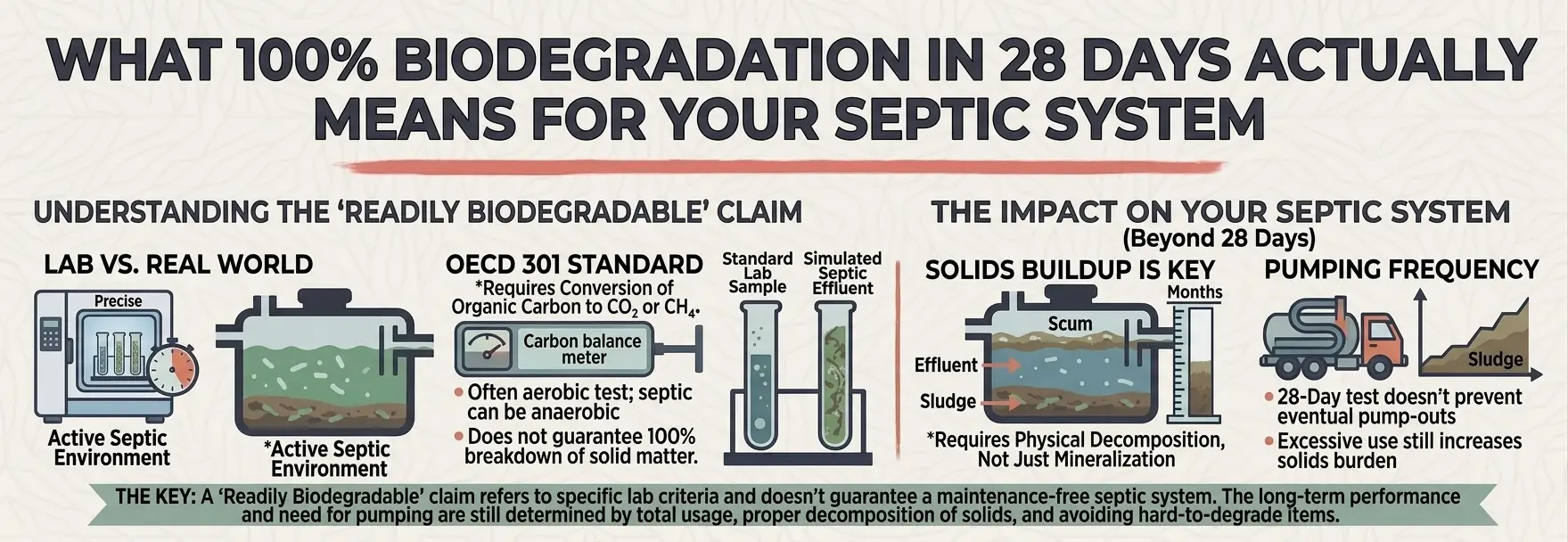
If you own a septic system, you have probably noticed that most toilet paper packages have some version of the word biodegradable on them. It is printed right there, in a reassuring font, next to the tree icon. And it means almost nothing on its own.
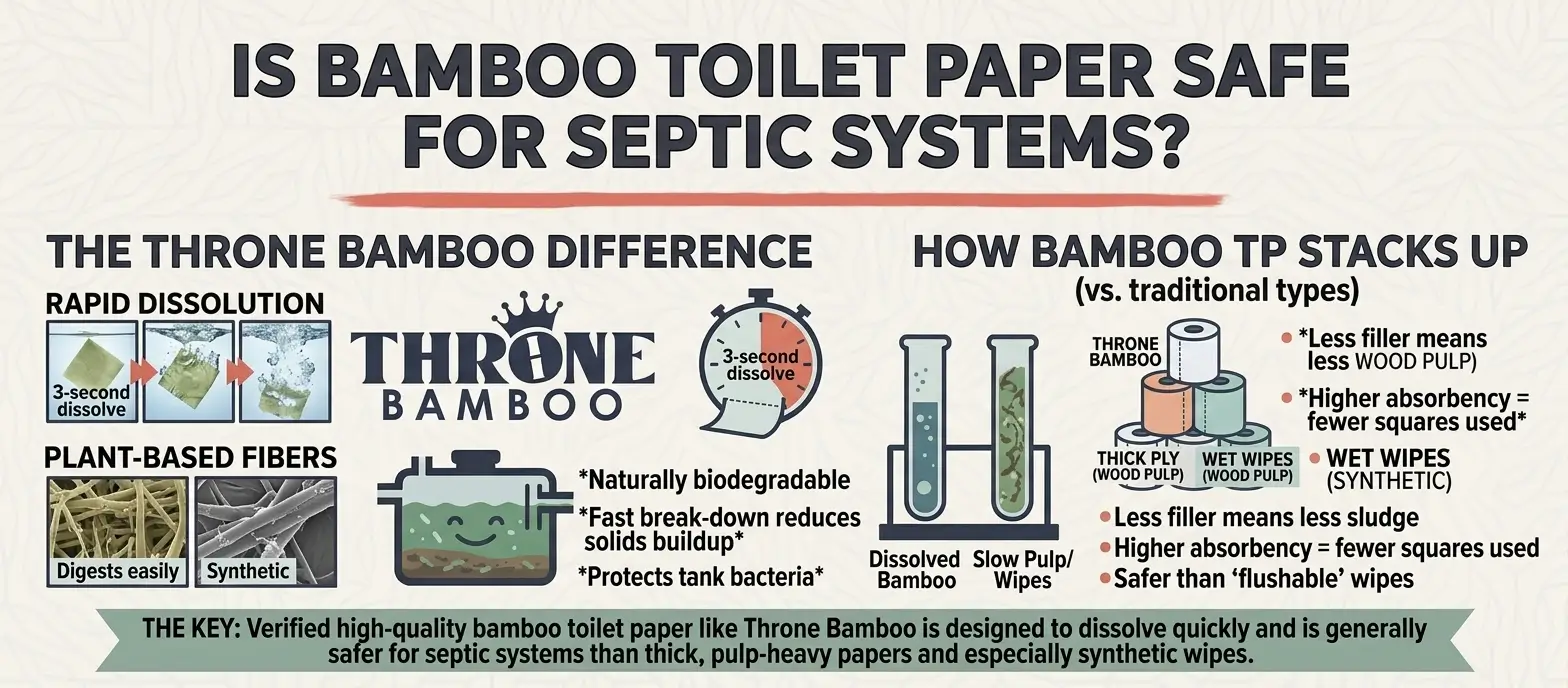
Bamboo toilet paper is safe for septic systems. But the more interesting answer is not just yes, it is yes and here is why it works better than most of the alternatives you have probably been using.