

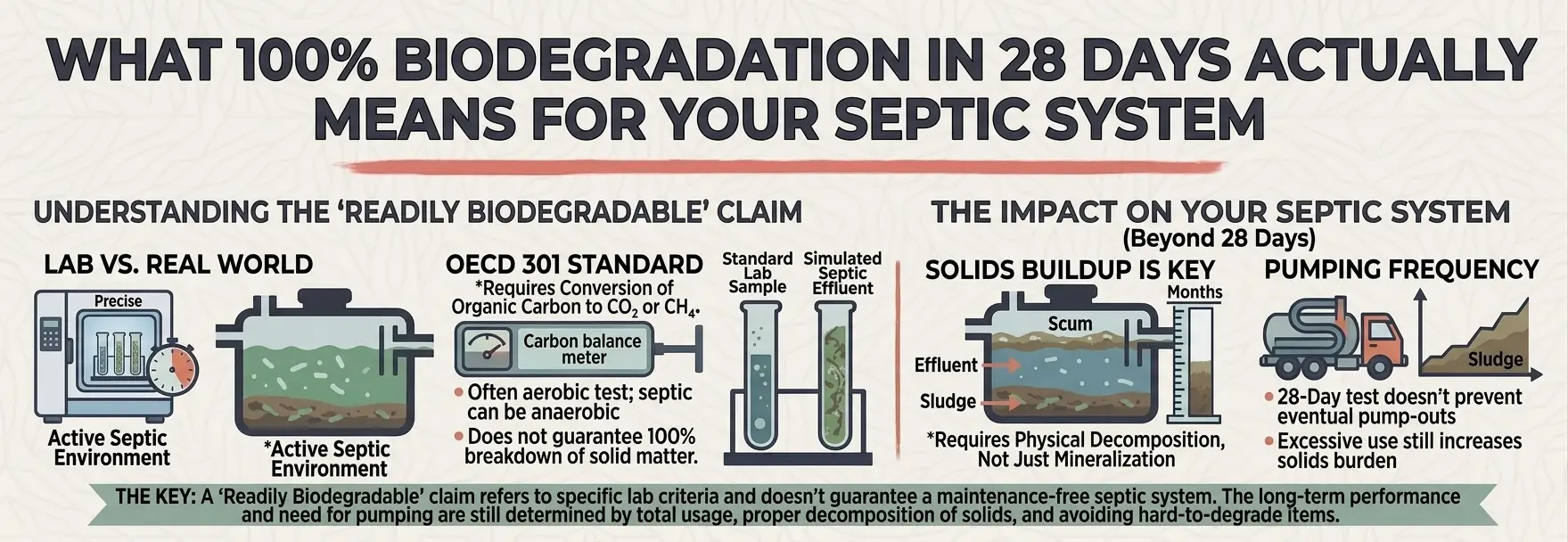
What 100% Biodegradation in 28 Days Actually Means for Your Septic System
If you own a septic system, you have probably noticed that most toilet paper packages have some version of the word biodegradable on them. It is printed right there, in a reassuring font, next to the tree icon. And it means almost nothing on its own.
The term biodegradable has no standard definition in the consumer toilet paper category. There is no regulatory requirement that a product biodegrade at a certain rate or to a certain level before using the word. A paper product that breaks down 60 percent over six months technically qualifies. So does one that breaks down 100 percent in under a month. They are not the same thing for your septic tank. Both products can use the same label.
That is where the 28-day benchmark becomes important. And why the difference between 95 percent and 100 percent biodegradation matters more than it sounds.
Dissolving and Biodegrading Are Two Different Things
What dissolution actually is
Most people conflate these two processes. When toilet paper hits water, it starts to break apart. That is dissolution. Fast dissolution is good for septic systems because it means the paper is not clogging pipes or forming solid masses in your tank.
Biodegradation is a completely different step. It is the process by which microorganisms, mostly bacteria and fungi, break down paper fragments into simpler compounds: carbon dioxide, water, and organic matter. The fragments do not just get smaller. They disappear into the environment.
A product can dissolve quickly and still biodegrade slowly. That combination causes real problems over time because partially biodegraded material accumulates in the sludge layer at the bottom of your tank. It just sits there, taking up space, and making your tank fill up faster than it should.
How the 28-day test works
Independent testing organizations like SGS run biodegradation assessments using internationally recognized protocols. The testing places a measured amount of toilet paper in an environment that simulates conditions found in a real-world septic or aquatic system, with active microbial populations and appropriate temperature and chemistry.
At 28 days, the testing measures how much of the original material has been converted into carbon dioxide and water by microbial activity. A product that reaches 100 percent at that mark has fully biodegraded. A product that reaches 95 percent has left behind 5 percent of its original mass in a form microorganisms have not yet broken down.
Throne Bamboo is tested by SGS and reaches 100 percent biodegradation within 28 days. The industry minimum for septic-safe certification typically sits at 95 to 98 percent. Throne Bamboo exceeds that standard with a margin that translates into a real difference for your system over time.
Why the Gap Between 95 and 100 Percent Adds Up
Running the math on residual accumulation
Five percent sounds like a rounding error. It is not, when you think about it over a full year of household toilet paper use.
The average household of four goes through somewhere between 400 and 500 rolls of toilet paper per year. If each roll leaves behind 5 percent of its mass in a form that does not biodegrade within the testing window, that residual fraction accumulates in the sludge layer of your tank. The bacterial activity in your tank will continue breaking down some of that material over time, but not at the same rate as fully biodegradable fiber. The practical result is that sludge accumulates faster, your tank needs pumping more frequently, and if the sludge layer gets high enough before you pump, solids start passing into the drain field.
Drain field damage is not a slow warning
Drain field damage tends to announce itself suddenly. The lawn gets soggy in a spot above the field. Drains slow down across the whole house at once. The smell arrives. By the time those signs show up, the damage has often been building for a while.
Repair costs range from several thousand dollars on the low end to well over twenty thousand if the soil around the field has become compacted and saturated. The investment in slightly better toilet paper, one that biodegrades fully rather than mostly, is genuinely small relative to that kind of repair bill.
Why Bamboo Biodegrades Better Than Wood Pulp
The lignin difference
Bamboo is a grass. Tree-based toilet paper is made from wood pulp. One of the key structural differences between them is lignin content. Lignin is a complex organic polymer that gives wood its rigidity and makes wood-pulp fibers resistant to biodegradation. Bamboo fiber contains significantly less lignin than wood pulp. The bacterial and fungal populations in your septic tank can access and break down bamboo fiber more readily, which is part of why bamboo toilet paper consistently performs better in biodegradation testing.
No additives interfering with tank biology
Conventional toilet paper often contains synthetic fragrances, dyes, and optical brighteners that do not biodegrade efficiently. Some can also disrupt the bacterial populations in your tank, the same bacteria doing the work of breaking down waste. A fragrance compound with mild antimicrobial properties is a problem in a sealed septic environment where you need those microorganisms healthy and active.
Throne Bamboo contains no PFAS, no BPA, no synthetic fragrances, and no dyes, and is produced using an Elemental Chlorine Free (ECF) process.
Biodegradability Claims on Packaging
What to look for beyond the label
When you see biodegradable on a toilet paper package, the useful question to ask is whether the brand can communicate the actual test results from an independent laboratory.
What you are looking for is a specified biodegradation percentage, a specified timeframe, and the name of the independent testing organization. A product that says 100 percent biodegradable without those specifics is making a marketing statement. A product that says 100 percent biodegradation in 28 days, tested by SGS, with documentation available if requested, is making a verifiable claim.
Common Questions About Biodegradation and Septic Systems
Does biodegradation rate change in cold weather?
Yes. Microbial activity slows at lower temperatures, which means biodegradation in your septic tank will be slower in winter than in summer. This is a natural variation and does not mean you need to pump more frequently in cold months, but it does mean that a product with a faster biodegradation rate has a proportionally larger advantage during cold periods when the bacterial activity in your tank is already reduced.
Can I tell if my toilet paper is biodegrading properly without testing it?
Not directly. The biodegradation process happens inside your tank and is not visible from outside. The indirect signals are pump-out frequency and how quickly your tank fills between pump-outs. If your tank seems to need pump-outs more frequently than the guidelines suggest for your household size and tank capacity, the biodegradation rate of your toilet paper is worth examining alongside other contributing factors.
Does every bamboo toilet paper biodegrade at the same rate?
No. The biodegradation rate depends on the raw material, the manufacturing process, and any additives in the finished product. Bamboo fiber biodegrades faster than wood pulp as a rule, but a bamboo paper with synthetic fragrances and optical brighteners will not biodegrade as cleanly or as quickly as one without those additives. The testing documentation is the only reliable way to know where a specific product actually falls.
The Practical Takeaway for Septic System Owners
Switching to fully biodegradable toilet paper is not a dramatic lifestyle change. The rolls look the same. They perform the same in use. The difference is entirely in what happens after they are flushed, in the biological processing environment of your tank, and in the long-term accumulation rate of the sludge layer.
Over three to five years, the difference between a product that biodegrades 95 percent and one that biodegrades 100 percent shows up in maintenance costs and system health, even if it is invisible day to day. The 28-day biodegradation number is the most specific, testable claim you can look for when buying toilet paper for a septic system. It is more meaningful than septic safe on a label and more informative than biodegradable as a general descriptor. And it is the number Throne Bamboo has earned through independent testing, not just printed on the package.
More blog posts
If you own a septic system, you have probably noticed that most toilet paper packages have some version of the word biodegradable on them. It is printed right there, in a reassuring font, next to the tree icon. And it means almost nothing on its own.
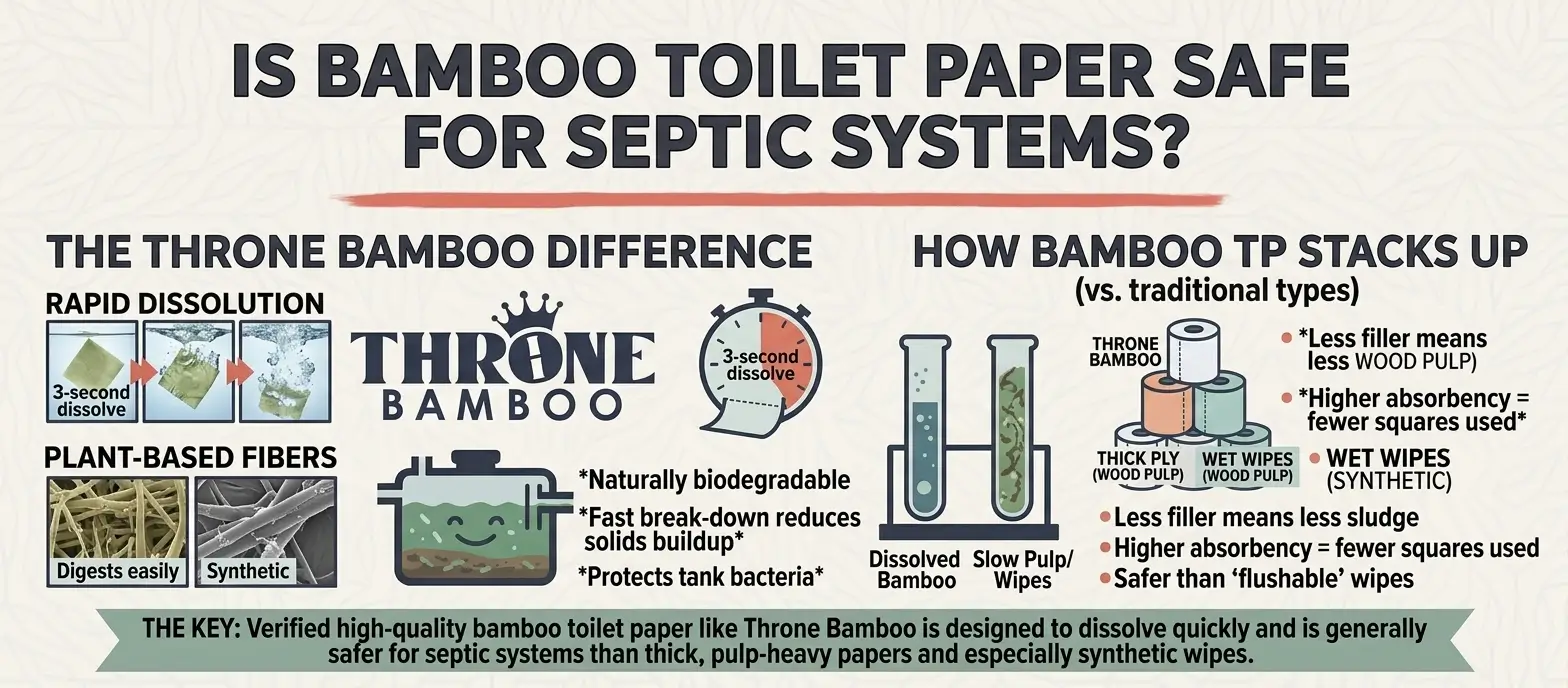
Bamboo toilet paper is safe for septic systems. But the more interesting answer is not just yes, it is yes and here is why it works better than most of the alternatives you have probably been using.