

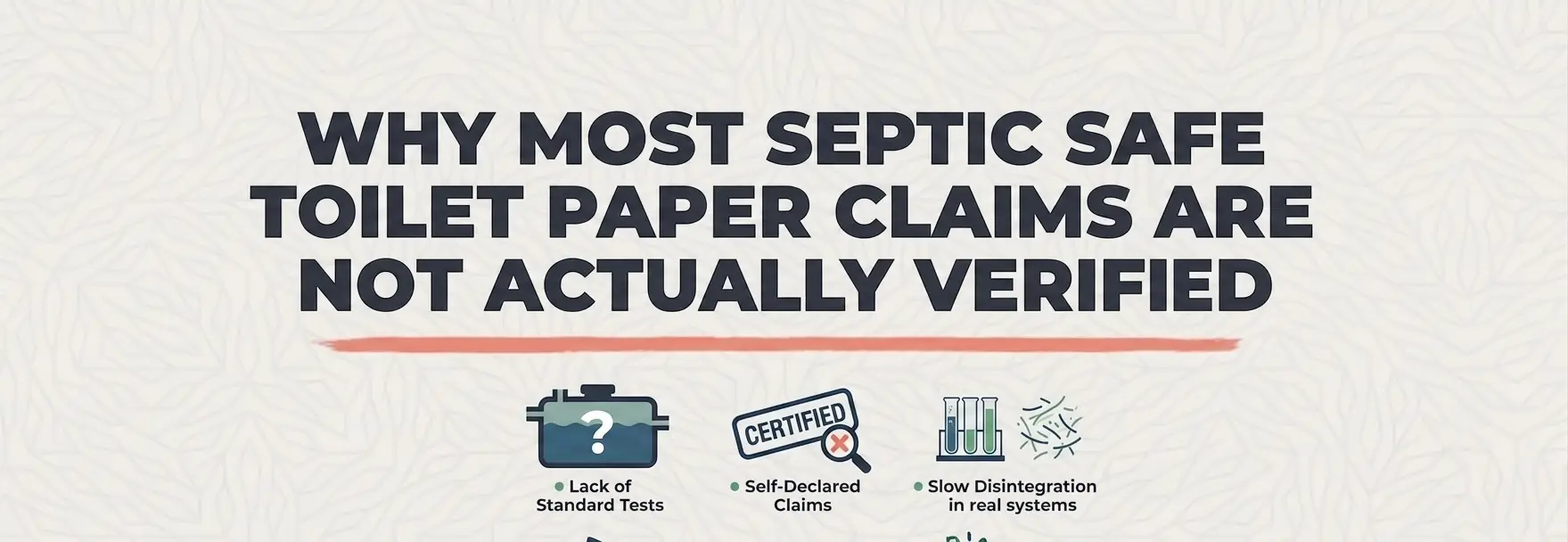
Why Most Septic Safe Toilet Paper Claims Are Not Actually Verified
Walk through any grocery store toilet paper aisle and count how many packages use the words septic safe. Almost all of them. Conventional brands, eco brands, generic store labels. The phrase is everywhere.
Now ask how many of those brands have published independent laboratory test results showing their product meets a defined septic-safe performance threshold. That number is much smaller.
This disconnect is not accidental. In the United States, there is no regulatory requirement for a toilet paper brand to test or prove its products before using the words septic safe on packaging. The phrase is marketing language, not a certification. And for homeowners with septic systems who are trying to protect a piece of infrastructure that can cost tens of thousands of dollars to repair, that matters.
What 'Septic Safe' Actually Should Mean
The two things that matter most
A toilet paper that is genuinely safe for septic systems needs to do two things well. First, it needs to dissolve quickly in water so it does not accumulate as undissolved solid material in your tank or clog the pipes between your house and the tank. Second, it needs to biodegrade fully so that once the paper fragments enter the bacterial environment of your tank, they break down completely rather than adding to the sludge layer.
Dissolution speed and biodegradation rate are testable, measurable qualities. They produce specific numbers. A product that begins dissolving in 10 minutes is measurably different from one that takes 45 minutes. A product that biodegrades 100% in 28 days is measurably different from one that biodegrades 85% in the same window.
When a toilet paper brand uses the phrase septic safe without providing either of those numbers with independent testing to back them up, they are not making a falsifiable claim. They are not saying anything that could be checked or disputed. That is very convenient for them and very unhelpful for you.
The flushability trap
A related phrase that causes even more confusion is flushable. Technically, most toilet paper and many wet wipes will go down the toilet without immediately causing a clog. That is all flushable means in the most literal sense. It says nothing about what happens downstream.
Products labeled flushable but not specifically tested for septic compatibility have been shown in independent research to cause significant problems in both septic systems and municipal sewage infrastructure. The distinction between flushable and septic safe is real, and it matters. A product can clear your toilet bowl and still do damage to your tank.
How to Tell Whether a Brand Has Actually Tested
Look for a named testing organization
Real verification involves a specific, named, independent laboratory. SGS, Eurofins, Bureau Veritas, NSF International. These organizations have no financial stake in the outcome of testing. They run standardized protocols and report actual numbers.
A brand that has had its product tested by one of these organizations should be able to tell you which organization ran the testing, what protocol was used, and what the results were. If the answer to any of those questions is vague or unavailable, the testing may not have happened or was not conducted by a genuinely independent party.
Specific numbers, not general claims
Meaningful testing produces specific results. Not claims like our product dissolves quickly or biodegrades naturally. Actual numbers: dissolution begins within X minutes, biodegradation reaches Y percent within Z days.
When you compare a package that says septic safe in large font with no further detail against one that cites independent SGS testing showing 100% biodegradation within 28 days and dissolution beginning in 10 minutes, you are comparing two fundamentally different things. One is a phrase designed to sell toilet paper. The other is a verifiable performance claim.
Why Brands Get Away With Unverified Claims
No regulatory standard exists
There is no government regulation in the United States that defines septic safe for toilet paper. There is no required testing before a brand can use the phrase. There is no enforcement mechanism for brands that use the phrase without support.
The result is a completely unregulated claim appearing on nearly every product in the category. Consumers have no way to distinguish a meaningfully tested product from one that simply adopted the phrase because it tested well in focus groups.
Most consumers do not know to ask
The second reason brands get away with it is that most people buy toilet paper based on softness, price, and whatever sounds environmentally responsible. The question of whether the septic-safe claim is verified does not occur to most shoppers because there is no obvious reason it would not be.
Homeowners with septic systems tend to become more skeptical once they have had a problem. A clogged line, an early pump-out recommendation, a soggy patch on the lawn above the drain field. Those experiences prompt people to actually look into what they are flushing. But by then, the damage may already have been building for years.
What Throne Bamboo Does Differently
Third-party testing with SGS
Every batch of Throne Bamboo toilet paper is tested by SGS, one of the most widely recognized product testing and certification organizations in the world. SGS has no affiliation with Throne Bamboo. Their job is to test the product and report the results accurately.
In SGS testing, Throne Bamboo begins dissolving in as little as 10 minutes. The industry standard flushability test runs for 60 minutes. Throne Bamboo reaches 100% biodegradation within 28 days. The industry threshold for septic-safe certification is typically 95 to 98 percent.
A Practical Guide for Septic System Owners
When you are buying toilet paper for a home with a septic system, here is a quick framework that cuts through the label noise.
Ask whether the brand can show you independent test results from a named laboratory. If the answer is no or vague, move on. Ask specifically about biodegradation percentage and timeframe. Ask about dissolution speed. These are not technical questions. Any brand that has done the testing can answer them plainly.
Look for products made from bamboo or other fast-biodegrading fibers rather than heavily processed wood pulp. Look for products that are free from fragrances, dyes, and additives that can disrupt your tank’s biological balance. And look for transparency. A brand that publishes its test results is making a different kind of promise than one that just prints septic safe on the package.
Your septic system is a piece of infrastructure that you depend on every day and that costs real money to maintain and repair. The toilet paper you choose is one of the simplest and most direct levers you have over its long-term health. It is worth spending two minutes checking whether the brand you are buying has actually verified the claims on the label.
More blog posts
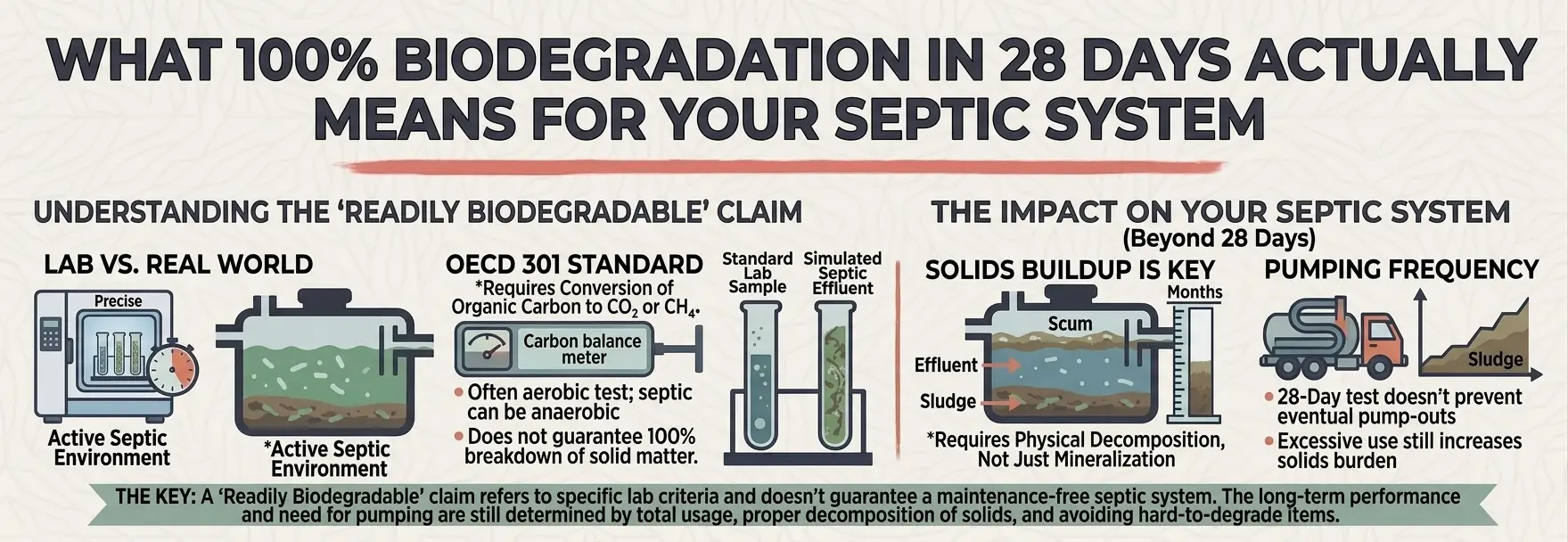
If you own a septic system, you have probably noticed that most toilet paper packages have some version of the word biodegradable on them. It is printed right there, in a reassuring font, next to the tree icon. And it means almost nothing on its own.
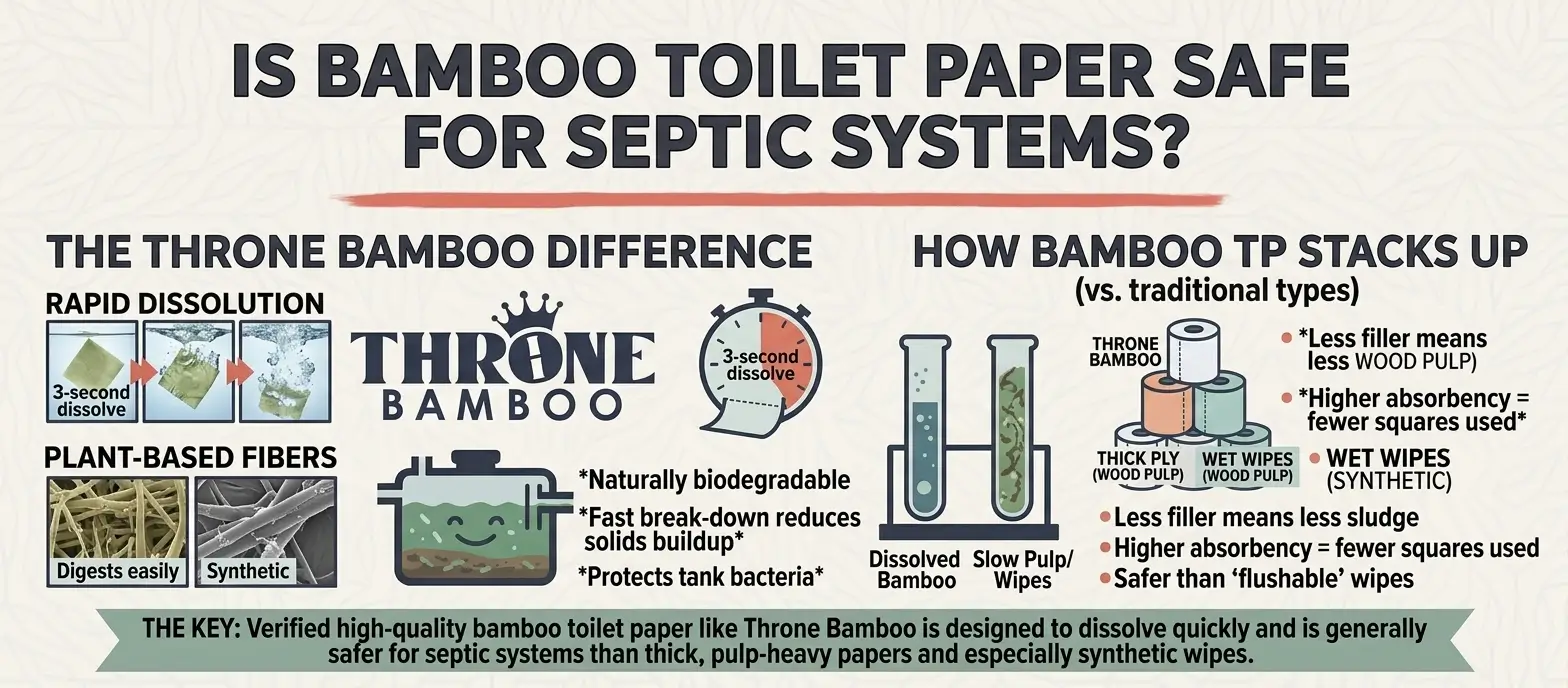
Bamboo toilet paper is safe for septic systems. But the more interesting answer is not just yes, it is yes and here is why it works better than most of the alternatives you have probably been using.