

How Toilet Paper Damages Your Septic System Over Time
Nobody moves into a house with a septic system thinking their toilet paper choice is going to become an expensive problem. The connection between what you flush and what happens underground is not obvious, and the consequences are slow enough that most people never connect them.
That is exactly how the damage happens. Not in a single dramatic clog or failure, but quietly, over the course of years, in a process that is invisible from above ground until the lawn gets soggy, the drains slow down across the whole house, or a septic service tech tells you that your drain field is failing.
Understanding how toilet paper contributes to that process is the first step to interrupting it.
How a Septic System Is Supposed to Work
The basic process
A standard septic system has two main components: the tank and the drain field. Wastewater from the house flows into the tank, where it separates naturally. Solids settle to the bottom as sludge. Lighter material like grease floats to the top as scum. The liquid layer in the middle, called effluent, flows out through a pipe into the drain field.
In the drain field, that effluent passes through perforated pipes into gravel-filled trenches, then slowly filters down through the soil before returning to the groundwater. Bacteria in the soil finish the treatment process. The whole system depends on the effluent being liquid and relatively free of solids by the time it reaches the drain field.
The role of bacteria
Your septic tank is not just a storage container. It is a biological processing environment. Anaerobic bacteria break down organic waste in the sludge layer continuously. That bacterial activity is what makes the system function. Without it, sludge accumulates faster than any pump-out schedule can handle.
Those bacteria are sensitive to what enters the tank. Antibacterial compounds, synthetic fragrances, chlorine, and certain chemical additives can reduce bacterial populations and slow the breakdown process. This is one of the less obvious ways that toilet paper affects septic system health.
The Sludge Layer: Where the Problem Starts
What goes into the sludge layer
Every flush adds something to the sludge layer at the bottom of your tank. Most of it is waste. Some of it is toilet paper that has not fully dissolved or biodegraded. The bacterial population in your tank breaks down some of this material continuously, but not all of it. The fraction that bacteria cannot process, including paper fibers that are slow to biodegrade, accumulates.
The rate of accumulation depends on how much is entering the tank, how active the bacterial population is, and how quickly the paper itself biodegrades. Slow-dissolving toilet paper that does not fully biodegrade adds to the sludge layer faster than a tank’s natural processes can compensate for.
What happens as sludge builds up
As the sludge layer grows, the working volume of your tank shrinks. A 1,000-gallon tank with a foot of sludge at the bottom has meaningfully less capacity than the same tank with six inches of sludge. More frequent pump-outs become necessary. If pump-outs are delayed, the sludge layer can rise high enough that solids begin passing into the drain field outlet pipe.
Once solids enter the drain field, the problem escalates quickly. Solid material clogs the pores in the soil around the drain field pipes. That clogging reduces the drain field’s ability to absorb effluent. Water backs up. The lawn above the field gets saturated. Drains in the house slow down. The system is failing.
The Drain Field: The Most Expensive Part of the Problem
Why drain field damage is serious
A drain field is a network of perforated pipes buried in gravel-filled trenches, typically extending across a significant area of your property. The soil around those pipes is the final stage of the treatment process. When that soil becomes clogged with biomat, a layer of organic material that forms when too many solids enter the drain field, the field stops working.
Drain field repair ranges from several thousand dollars for a localized fix to fifteen thousand or more for a complete replacement. In poor soil conditions or in areas where space is limited, the costs go higher. Some properties require engineered solutions that cost significantly more.
The contributing factors to drain field failure are not always obvious from above ground. One of the most consistent contributors is a tank that has been allowed to accumulate solids faster than it should because of slow-biodegrading toilet paper.
The timeline of damage
This is the part that surprises most people. Drain field damage from septic system mismanagement does not happen in a year. The timeline is typically five to fifteen years of gradually worsening conditions before failure becomes obvious. That means the toilet paper choices you make today have consequences that will show up years from now, possibly after you have long since stopped thinking about them.
It also means that switching to a better toilet paper now will not immediately repair whatever damage has already accumulated. But it does stop the acceleration. Fully biodegrading paper stops adding residual mass to the sludge layer. The tank processes what enters it more efficiently. The drain field gets effluent that is closer to what it was designed to receive.
How Chemical Additives Make Things Worse
Fragrances and the bacterial balance
Many conventional toilet paper brands contain synthetic fragrances. These are complex chemical mixtures, not single compounds, and some of them have mild antimicrobial properties. In your bathroom, that is irrelevant. In your septic tank, it is a problem.
Your tank depends on active, healthy bacterial populations to break down sludge continuously. Introducing antimicrobial compounds with every flush suppresses those populations over time. The bacterial breakdown slows. Sludge accumulates faster. The cycle accelerates.
Dyes and optical brighteners
Optical brighteners are synthetic compounds used to make toilet paper appear whiter. They do not biodegrade efficiently. They pass through the tank into the effluent and can affect the soil biology in the drain field. Dyes from colored or printed toilet paper have similar effects.
Neither optical brighteners nor dyes serve any functional purpose in toilet paper. They are cosmetic. And in a septic system context, they are liabilities.
What Fast-Dissolving, Fully Biodegradable Toilet Paper Actually Changes
Less residual accumulation
Toilet paper that dissolves quickly does not sit in your pipes or form solid accumulations in your tank. Throne Bamboo begins dissolving in as little as 10 minutes in independent SGS testing. Paper that breaks apart that quickly enters the biological processing environment of your tank in a form that bacteria can work on immediately.
Toilet paper that biodegrades fully, 100 percent within 28 days in Throne Bamboo’s case, does not leave a residual fraction in the sludge layer. What goes in comes out as carbon dioxide, water, and organic matter that can move through the effluent. The sludge layer grows more slowly.
Supporting the bacterial environment
Throne Bamboo contains no fragrances, no dyes, no PFAS, and no BPA. It is produced using an Elemental Chlorine Free (ECF) process. Nothing in the finished product suppresses bacterial activity or introduces compounds that do not belong in a biological treatment environment.
That matters more than it sounds. A septic system with a healthy bacterial population processes waste more efficiently, maintains the sludge layer at a lower depth, and requires less frequent intervention. Good toilet paper does not fix a sick septic system. But it does not make a healthy one sick either.
The Long-Term Math
The average household spends three hundred to six hundred dollars on septic tank pumping every three to five years. Drain field repair, when it becomes necessary, costs several thousand to tens of thousands. Choosing toilet paper that reduces sludge accumulation and protects tank biology shifts that whole timeline. Pump-outs become less frequent. The drain field handles effluent properly for longer.
Throne Bamboo costs more per roll than the cheapest conventional toilet paper. On a per-use basis, accounting for Throne’s longer sheet length, the 24-pack costs approximately 25 percent less per use than a traditional mega roll. And none of that calculation includes the avoided cost of a drain field that does not need to be replaced in year twelve because it spent the first twelve years receiving effluent from a tank that was processing paper properly.
The connection between toilet paper and septic system health is not dramatic. It is slow, cumulative, and mostly invisible. That is exactly why it matters more than most people realize.
More blog posts
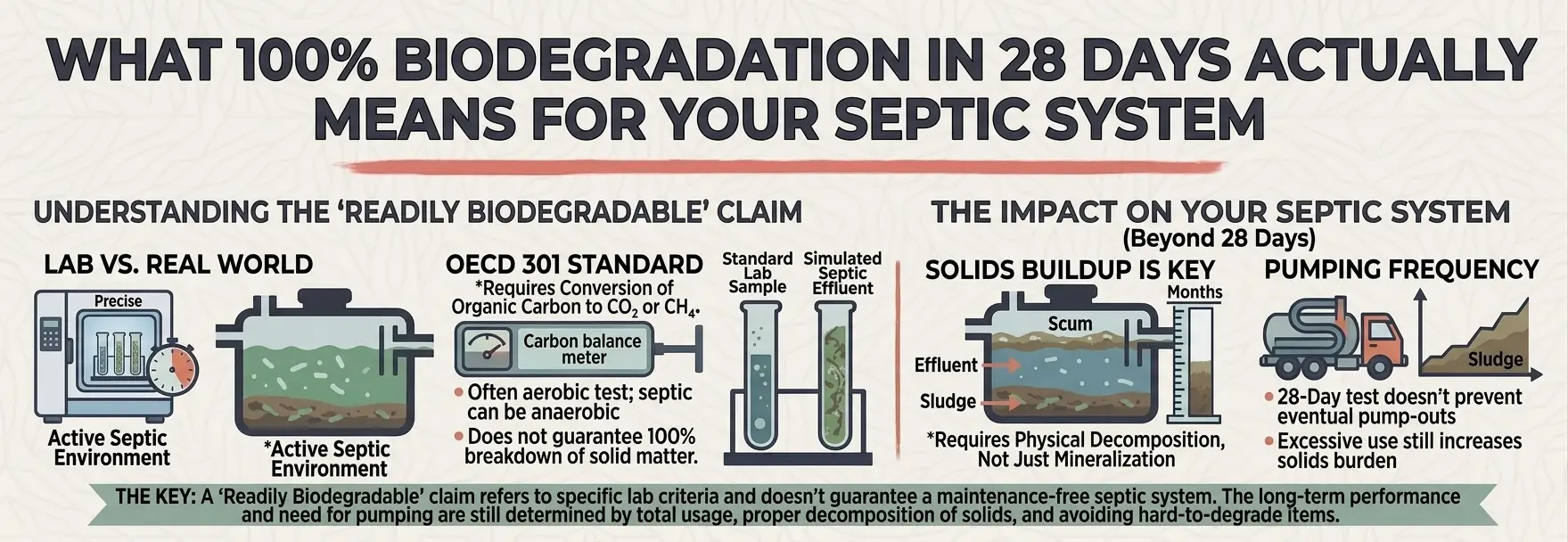
If you own a septic system, you have probably noticed that most toilet paper packages have some version of the word biodegradable on them. It is printed right there, in a reassuring font, next to the tree icon. And it means almost nothing on its own.
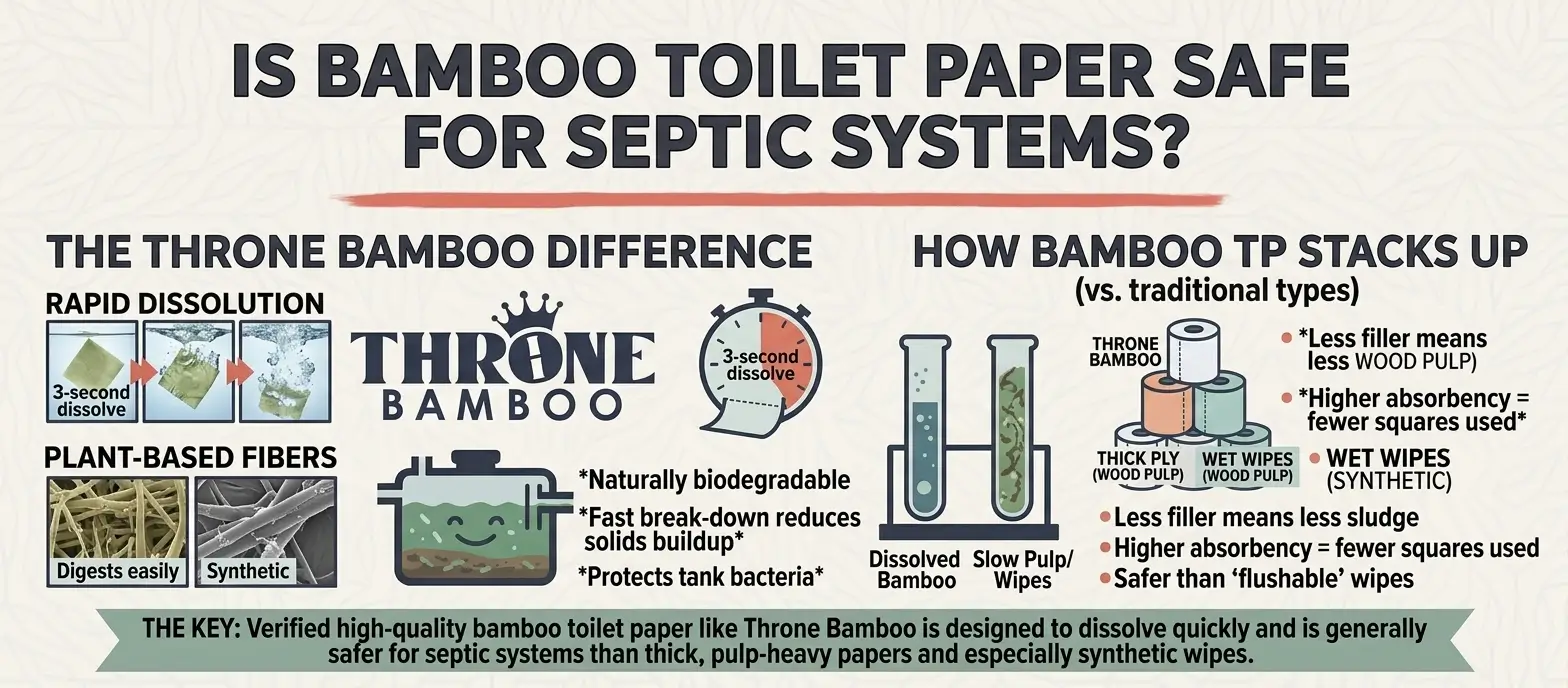
Bamboo toilet paper is safe for septic systems. But the more interesting answer is not just yes, it is yes and here is why it works better than most of the alternatives you have probably been using.